
Key facts
- Glaucoma damage is irreversible. SingHealth describes it as optic nerve damage resulting in irreversible loss of vision, and calls it the silent thief of sight (SingHealth).
- There is nothing to feel, in either direction. Neither the disease progressing nor the treatment working produces any sensation, which is why adherence collapses so quietly.
- The whole point of the drops is pressure. Lowering intraocular pressure is the main aim of treatment (SNEC).
- The visible side effects are why people stop, not the invisible disease, and most of them have answers.
- A beta blocker in the eye is still a beta blocker. Tell an eye doctor about asthma, COPD or a slow pulse.
- One drop is the whole dose. The eye physically cannot hold more, so a second is spillage.
- Heat and time both matter. The discard date after opening is not a formality, least of all in this climate.
Clearing out a drawer, you find the bottle at the back. Still half full. You turn it over and work out roughly when you opened it, and the answer is somewhere around four months ago, which means for a good part of that time you have not been treating anything at all.
And here is the thing that makes glaucoma different from almost every other condition: nothing told you. No pain, no blur, no headache, no warning. Your eyes felt exactly the same during the months you were treating them and the months you were not.
Why there is nothing to feel
Glaucoma damages the optic nerve, and it usually takes the periphery first. That is the part of vision you are least aware of having.
Your brain also actively works against you here. It does not present you with a black patch where information is missing. It fills the gap with a confident guess based on what surrounds it, and it does this so smoothly that people lose substantial peripheral vision while reporting that their sight is fine. By the time something is noticeable, a good deal has usually gone, and none of it returns.
That is why the diagnosis nearly always arrives sideways, during a routine eye test or an examination for something else, and why it lands so oddly. Somebody tells you that you have a serious eye condition, and you can see perfectly well while they say it.
Everything difficult about living with glaucoma follows from that single fact. You are asked to treat something you cannot perceive, every day, indefinitely, and the only feedback you will ever get is the absence of a disaster you would not have been able to see coming anyway.
What the drops are actually doing
The Singapore National Eye Centre puts the aim simply: reduce the pressure inside the eye while maintaining quality of life. Fluid is produced inside the eye and drains away continuously. If drainage falls behind production, pressure rises, and pressure is what damages the nerve.
So every drop does one of two jobs. It either helps fluid leave, or it slows fluid being made.
| Family | On this site | What it does |
|---|---|---|
| Prostaglandin analogues | latanoprost, bimatoprost, travoprost | Improve drainage. Usually the first choice, and used once daily |
| Beta blockers | timolol | Reduce how much fluid is produced |
| Carbonic anhydrase inhibitors | dorzolamide, brinzolamide | Also reduce production, by a different route |
| Alpha agonists | brimonidine | Both: less production, better drainage |
| Oral carbonic anhydrase inhibitor | acetazolamide | A tablet, used for short periods or when drops are not enough |
If one bottle does not bring the pressure down far enough, a second family is added rather than the first being abandoned. That is why people end up with two or three bottles and a sequence to remember, and it is a normal escalation rather than a sign of failure.
You can see what we list under eye care, or by condition under glaucoma and ocular hypertension.
The side effects nobody warned you about
This is the section that matters most, because the reason people stop treating glaucoma is almost never the glaucoma. It is something visible and irritating that arrived with the treatment, was never explained, and seemed like a reasonable trade against a disease with no symptoms.
The prostaglandins are the interesting ones. They can darken and thicken eyelashes, darken the skin around the eye, and, over years, permanently change the colour of a light-coloured iris. There is often some redness in the early weeks that settles. None of this harms the eye. All of it is startling if it arrives unannounced, and the lash effect is well enough known that the same molecule is sold cosmetically for exactly that purpose. Worth knowing, and not a reason to treat a glaucoma prescription as a beauty product.
Timolol is the one with a genuine safety point rather than a cosmetic one. A beta blocker dropped into the eye does not stay in the eye; it is absorbed and can act on the lungs and the heart. For someone with asthma or COPD, or an already slow pulse, that matters, and it is exactly the kind of detail that falls through the gap between an eye doctor who was not told and a family doctor who does not know about the drops. Tell both. If you have found yourself more breathless or more tired since starting, say so rather than pushing through.
The carbonic anhydrase drops sting, and often produce a bitter taste at the back of the throat a minute later, which surprises people who did not expect a medicine in the eye to have a flavour. Brimonidine can cause redness and drowsiness.
Every one of these has an answer: a different family, a preservative-free version, a change in technique. None of them is a reason to stop and say nothing, which is the response they most often get.
Getting them in
Technique is not fussiness here. It is most of the difference between a treated eye and a bottle you are using up.
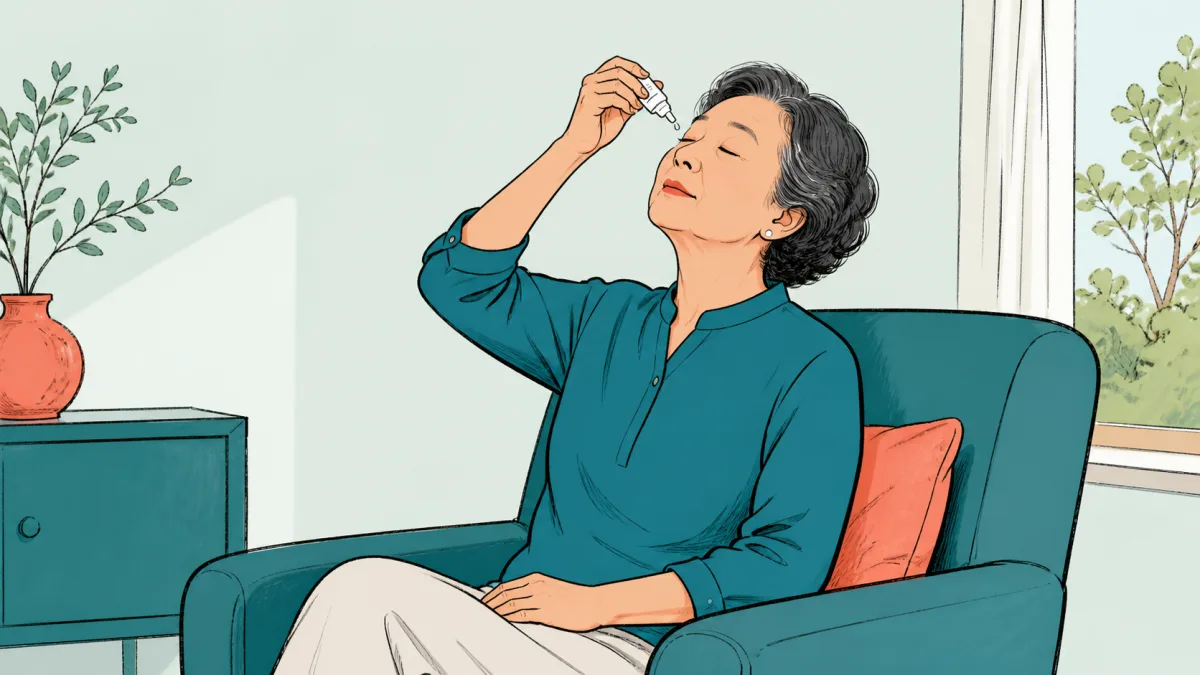
The eye holds far less fluid than a single drop delivers, so one drop is the entire dose and the second one you added because you were not sure the first went in is running down your cheek. Tilt back, pull the lower lid down to make a pocket, aim there rather than at the eyeball, and try not to touch the lashes or the eye with the tip of the bottle, which is how a bottle becomes contaminated.
Then close the eye gently and leave it closed for a minute or so rather than blinking hard. Blinking pumps the drop down the tear duct and into your throat, which is both how the bitter taste happens and how a beta blocker reaches your lungs.
If you use more than one bottle, leave a proper gap between them. Put the second in straight after the first and you have largely washed the first one out.
Heat, and the date on the bottle
The regional part, and the reason a perfectly good bottle can stop being a perfectly good bottle.
Eye drops carry a discard period after opening, typically much shorter than the printed expiry date, because once opened a bottle is no longer sterile and the preservative is only holding the line for so long. In a climate where the bathroom shelf sits warm and humid for months, and a bag left in a car reaches temperatures nobody designed for, that line holds less well.
The practical version is unglamorous. Write the date you opened it on the bottle. Keep drops out of direct sun, out of the bathroom, and out of vehicles. Note that some drops are refrigerated before opening and some are not, and the label decides that, not habit. Do not use anything that has changed colour or gone cloudy. The wider storage picture, and why the bathroom cabinet is the worst habit in this climate, is in medicines that do not survive your kitchen.
And the half-full bottle at the back of the drawer, four months on, is not a saving. It is a bottle to replace, and a conversation to have about the four months.
Also worth reading
For keeping a long-term prescription supplied across the region, see chronic medicines on a Thai retirement visa and buying medicine in Singapore. For matching a brand you were given elsewhere, see the medicine brand-name decoder.
FAQ
If I cannot feel any difference, how do I know the drops are working?
You do not, and you are not supposed to. The pressure check at your review is the feedback, which is the entire reason those appointments are not optional in the way they can feel.
I missed a few weeks. Have I lost vision?
Possibly not, and possibly a little that you would never notice. What is worth doing is restarting and saying so at the next appointment, honestly. Doctors are considerably more interested in the pattern than in the confession.
Can eye drops cure glaucoma?
No. They control the pressure that drives the damage, which protects the sight you currently have. Sight already lost does not come back, which is why treatment is about protecting the rest.
My eyelashes have grown noticeably. Is something wrong?
That is a recognised effect of the prostaglandin family and not a sign of harm. If it bothers you, or the skin around the eye has darkened, mention it, because there are alternatives.
Do I still need drops if my pressure is now normal?
Almost always yes, because the pressure is normal as a result of the drops. Stopping generally returns it to where it was. Whether treatment can ever change is a decision for the ophthalmologist monitoring you.
Sources
This article is general information, checked on 10 August 2026. It contains no doses and no dosing schedules, and it is not a substitute for care from an eye specialist.