

Key facts
- Heat lowers blood pressure on its own. Your medicine is still doing its job; the climate has started doing part of the same job alongside it.
- Fluid and salt losses through sweat are the other half, and they are largest in the first weeks before the body adapts.
- Diuretics are the class where the two effects meet most directly. The CDC lists diuretics and some blood pressure medicines among those that interfere with the body’s heat regulation and fluid balance (CDC).
- Do not skip doses on hot days. It is the most common response and the worst one, because blood pressure does not stay down while you wait.
- A single reading is not a change. A pattern across days, taken the same way each time, is what a doctor can act on.
- Dizziness on standing is worth reporting, not enduring. Falls do more damage than the reading that caused them.
- Everything here is a reason to book a review, not a reason to adjust anything yourself.
Three weeks after you move, you get up from a low sofa and have to wait for the room to come back. It lasts a few seconds. It happens again in a shopping centre car park, and once on the stairs, and by the end of the month you have quietly started holding on to things when you stand.
The conclusion most people reach is that something is wrong with the tablets. The likelier explanation is that nothing is wrong with the tablets and something is different about where you are taking them.
What the heat is doing
Warm skin needs blood in it. That is how the body sheds heat: vessels near the surface widen, more blood moves through them, and heat leaves. It is an elegant system and it has a side effect, which is that widened vessels across a large surface hold pressure lower.
At the same time you are losing fluid and salt through sweat, in quantities you were never losing them at home, doing nothing more strenuous than walking to lunch. Less volume in the system also means less pressure.
Now add a medicine whose entire purpose is to lower blood pressure. Nothing has gone wrong. Three things are pulling in the same direction, and only one of them was in the plan when the dose was set.
The World Health Organization notes that people on certain long-term medicines are among those at higher risk in the heat, which is not a warning against the medicines but a reason to be deliberate. The CDC’s clinical guidance on heat and medications is more specific, describing how some medicines interfere with the body’s own temperature and fluid regulation and naming diuretics, some antipsychotics, some antidepressants and some blood pressure medicines among them.
This is also why the effect fades. Most people acclimatise over several weeks: you sweat sooner and more efficiently, and you lose less salt doing it. The difficult window is the beginning, which is exactly when a new arrival is least likely to have found a doctor.
Where each class sits
Blood pressure medicines are not one thing, and the heat does not treat them alike.
| Class | Examples on this site | What the heat adds |
|---|---|---|
| Thiazide and thiazide-like diuretics | hydrochlorothiazide, chlorthalidone, indapamide | The most direct overlap. They remove fluid and salt by design, and sweat removes more. |
| Loop diuretics | furosemide | Stronger again, usually prescribed for a reason that makes stopping worse than the dizziness. |
| Potassium-sparing diuretics | spironolactone | Fluid loss plus a mineral balance that heat can shift, which is why blood tests matter here. |
| ACE inhibitors | perindopril, ramipril, lisinopril | Less direct, but they relax vessels that the heat is already relaxing. |
| Angiotensin receptor blockers | losartan, olmesartan, telmisartan | Much the same, generally with less cough. |
| Calcium channel blockers | amlodipine | Widen vessels directly, so the effect stacks neatly with what warm skin is doing. |
| Beta blockers | metoprolol, bisoprolol | Different problem: they blunt the heart-rate rise the body uses to cope with heat and exertion. |
The last row is worth a sentence of its own. Beta blockers do not mainly cause the dizziness of low pressure; they limit how much the heart can speed up when you need it to. In a hot climate, on a steep footbridge, in traffic, that shows up as feeling flattened rather than faint. People frequently report it as tiredness and never connect it to the weather.
You can browse the full shelf under heart and blood pressure or by condition under hypertension and heart failure.
The mistake, said plainly
A large number of people, feeling light-headed on a hot day, skip that day’s tablet.
It is an understandable piece of reasoning and it is the wrong one. Blood pressure does not politely stay where you left it; some medicines produce a rebound when they stop abruptly, and the underlying pressure returns whether or not the weather is pleasant. You get the risk of an uncontrolled day and none of the benefit you were hoping for, and because the dizziness usually passes on its own you conclude that skipping worked.
If the light-headedness is real and repeated, that is a genuine finding and it deserves a genuine response, which is a review. There are several things a doctor can do about it, and most of them are unavailable to you on a Sunday with a strip of tablets and a hunch.
What a home reading is and is not
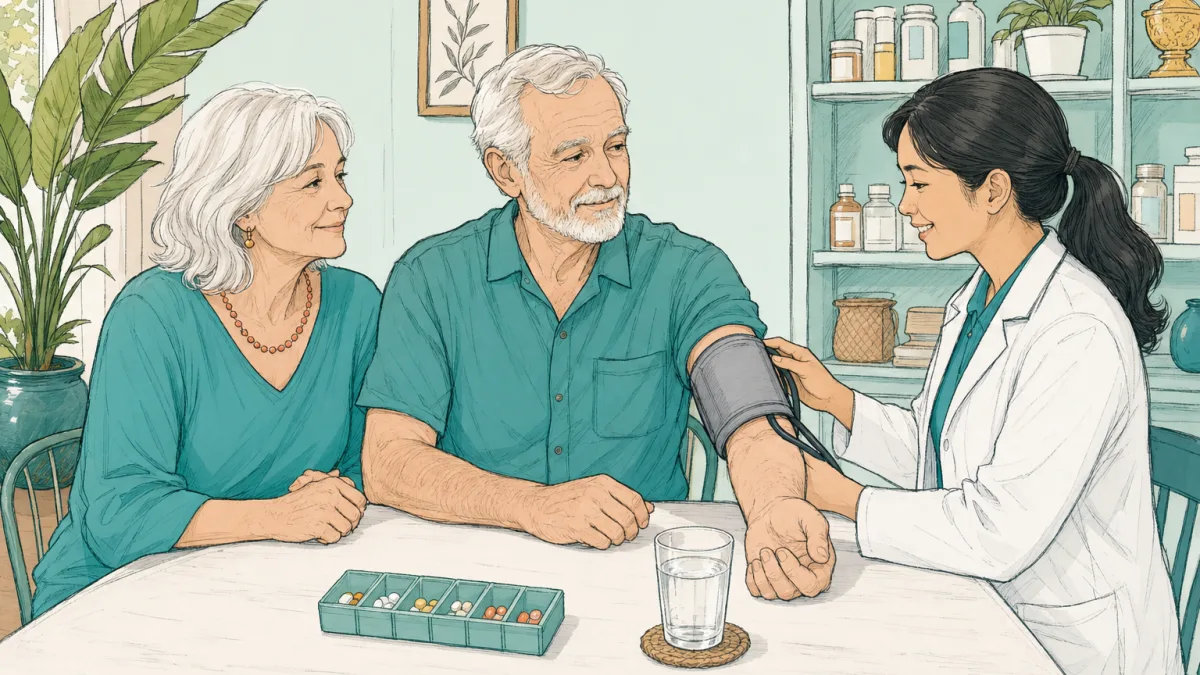
Home monitors are useful and they are also the source of a great deal of unnecessary worry, because a single number is almost meaningless.
Blood pressure moves all day. It is higher in the morning, it responds to the walk you took to get to the chair, it responds to the cuff being the wrong size and to the arm being unsupported and to the conversation you were having a minute earlier. In a hot climate it also moves with the time of day in a way that a temperate-country reading routine was never designed around: a reading taken after coming in from outside is measuring the last twenty minutes as much as it is measuring you.
What is useful is a series. Same time of day, same chair, same arm, several days in a row, written down. That is a pattern, and a pattern is something a doctor can act on. One reading after a walk in the sun is a story about the walk.
When the dizziness is not the medicine
There is an overlap worth knowing, because the early signs of heat exhaustion look a great deal like the effect described above: light-headedness, weakness, nausea, a headache, skin that is clammy rather than dry.
The difference generally shows itself in how it responds. Getting into shade, cooling down and taking fluids resolves heat exhaustion fairly quickly. Confusion, a very high temperature, a racing pulse, fainting, or someone who has stopped sweating altogether is a different situation entirely and needs urgent care rather than a rest and a glass of water.
The reason this belongs in an article about medicine is that people on diuretics start further along that path than everyone else around them, having begun the day with less fluid in reserve. It is not that the medicine is dangerous. It is that the usual margin is thinner, and worth knowing about before a long afternoon outdoors.
One thing to be careful about: this is not an invitation to add salt back. Sweat losses are real, but the correction depends on which medicine you take and why, and it is genuinely unsafe to improvise in heart failure or on certain diuretics. Ask.
The other heat problem, briefly
Storage. Almost every box says to store below 30°C, a line written by people who assumed a European cupboard. A closed flat in the afternoon comfortably exceeds that, a car glovebox exceeds it dramatically, and a motorbike delivery in April spends its journey somewhere between the two.
Most tablets are more robust than people fear, and a single warm afternoon rarely matters. Sustained heat over months is a different question, and the answer varies by product. As a rough rule, keep them out of direct sun and away from the kitchen and the bathroom, both of which are hotter and damper than the rest of the home. We go through this properly in medicines that do not survive your kitchen.
Also worth reading
For keeping a long-term prescription supplied across the region, see chronic medicines on a Thai retirement visa and maintenance medicines in the Philippines. For the cholesterol half of the same review, see high cholesterol and statins in Singapore. For matching a brand you were given at home to what is sold here, see buying generic medicines in Asia.
FAQ
Does everyone need a lower dose in a hot country?
No, and that is the point of asking rather than assuming. Some people need no change at all, some need one temporarily during the first weeks, and some are on a medicine for a reason that makes reducing it a bad idea regardless of the weather.
How long does it take to adjust to the heat?
Most of the adaptation happens over the first couple of weeks and continues more slowly after that. If the light-headedness is still there after a month or two, it is less likely to be acclimatisation and more likely to be worth a look.
Should I drink more water?
Generally yes in a hot climate, but there is a limit to how useful that advice is on its own, and there are conditions where fluid intake is deliberately restricted. If you have heart failure or kidney disease, or take a diuretic for something other than blood pressure, ask what the right amount is for you rather than following a general rule.
My reading is lower here than it was at home. Is that good?
It might be, or it might be lower than intended. Blood pressure that is too low has its own consequences, including falls. Bring the readings to a review instead of drawing the conclusion yourself.
Can I take my monitor readings as a reason to change my own dose?
No. They are excellent evidence and a poor instruction. Collect them, bring them, and let the change be someone’s clinical decision.
Sources
- CDC, heat and medications, guidance for clinicians
- World Health Organization, climate change, heat and health
- HealthHub Singapore, hypertension
- Singapore Ministry of Health, high blood pressure
This article is general information, checked on 10 August 2026. It contains no doses and no blood pressure targets, and it is not a substitute for advice from a clinician who knows your history.