
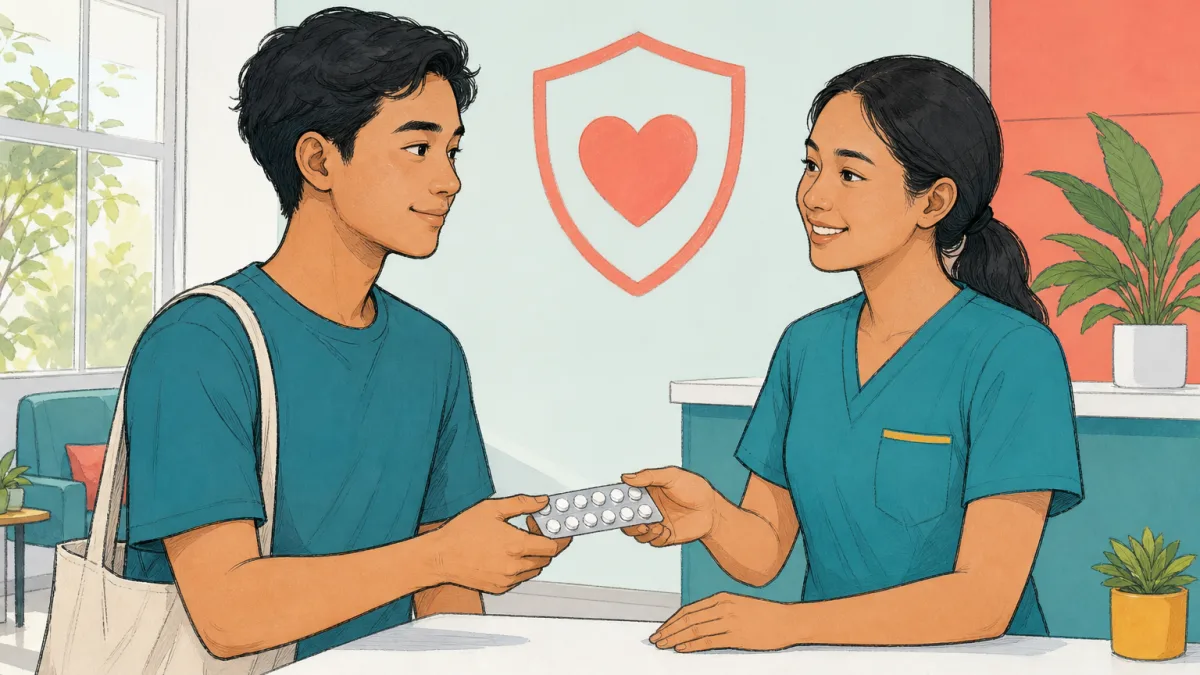
Thailand is one of the easier places in the world to start and stay on oral PrEP, the tablet form of the medicine that protects people who do not have HIV from getting it. The country was an early adopter, has well-run clinics that see international visitors every day, and offers PrEP at a fraction of what it costs in many Western countries. PrEP is not a medicine you simply pick up, though. It is started after an HIV test, taken on prescription, and kept under regular clinic checks. This guide explains what oral PrEP is, how well it works, the testing and monitoring that go with it, and where an expat or traveller can access it here.
Key facts
- Oral PrEP is tenofovir and emtricitabine, one of several prevention options the WHO recommends for people at substantial risk of HIV. WHO also lists the dapivirine vaginal ring and long-acting injectable cabotegravir and lenacapavir as additional choices. This guide covers the tablet.
- You must test HIV negative before starting, because PrEP is prevention, not treatment, and starting it with undetected HIV can cause resistance.
- PrEP needs ongoing HIV testing and kidney-function checks. The Love Foundation describes blood tests every 3 months while on PrEP.
- Taken consistently, oral PrEP lowers the risk of getting HIV from sex by about 99 per cent; the CDC puts the reduction from injection drug use at least 74 per cent when taken as prescribed.
- PrEP does not protect against other sexually transmitted infections, so it is used alongside condoms and regular STI screening.
- Thailand offers PrEP free under the NHSO national scheme, but eligibility is tied to that scheme and mainly benefits Thai nationals; most expats and travellers use a community or private clinic instead.
- Event-based dosing is only for adult gay and bisexual men and is not recommended by the CDC or approved by the FDA in the US. Daily PrEP is the option for everyone else.
- For a steady supply, settle with one clinic early and keep every follow-up appointment.
What is PrEP and how well does it work?
PrEP is the use of an antiretroviral medicine by HIV-negative people to reduce the risk of HIV acquisition. The WHO recommends TDF-based oral PrEP for people at substantial risk of HIV, as an additional prevention choice within comprehensive prevention. WHO also recommends the dapivirine vaginal ring, long-acting injectable cabotegravir and long-acting injectable lenacapavir as additional prevention choices for certain groups. This guide covers the oral tablet, tenofovir and emtricitabine.
The WHO recommendation for oral PrEP dates from September 2015. The US Centers for Disease Control and Prevention reports that, when taken as prescribed, oral and injectable PrEP reduce the risk of getting HIV from sex by about 99 per cent, and that oral PrEP reduces the risk from injection drug use by at least 74 per cent. Those estimates depend on adherence: the CDC says that if you do not take PrEP as prescribed, there may not be enough medicine in your bloodstream to block the virus. PrEP does not prevent other sexually transmitted infections, so it is used alongside condoms and STI screening, not instead of them.
Who is PrEP for?
PrEP is for people who do not have HIV but may be exposed to it. The CDC lists the situations that make someone a candidate: a sexual partner with HIV, anal or vaginal sex in the past 6 months without consistent condom use, a sexually transmitted infection in the past 6 months, or injection drug use with a partner who has HIV or shared needles or other injection equipment. The Love Foundation adds people with multiple partners, an unknown partner status, sex work, or more than one course of PEP in the past 12 months. A clinic confirms you are HIV negative first and sets up the testing that goes with PrEP.
Whether PrEP suits you is a decision for a clinician, not a general guide. This article covers how access, testing and monitoring work in Thailand.
What testing and monitoring does PrEP need?
You must test HIV negative before you start PrEP, and then repeat HIV testing and kidney-function checks at clinic visits. The Love Foundation describes the Thai process: an HIV test to confirm you are negative, a kidney function test, and sometimes screening for other STIs; blood tests are then repeated every 3 months. The CDC says a negative HIV test is required before prescribing PrEP, and that starting PrEP with undetected HIV can lead to drug-resistant HIV.
Follow-up is not a formality. The CDC recommends HIV antigen/antibody and HIV-1 RNA tests at least every 3 months, with a check for signs of acute HIV at the same visit. Kidney function is monitored during oral PrEP, and clinics also screen for STIs: syphilis and gonorrhoea for all PrEP users, and chlamydia for gay and bisexual men, even when there are no symptoms. The exact schedule is set with your clinic.
Where can expats and travellers get PrEP in Thailand?
Through a clinic: hospitals, private clinics, and community key population-led health services all provide PrEP, and in the cities you usually have several within reach. Thailand is recognised as a regional leader in providing PrEP, and the community clinics in particular are staffed by people from the communities they serve and are used to international clients.
Thailand also offers PrEP free under its national health scheme, run by the National Health Security Office. The Love Foundation reports that the NHSO added PrEP as a health benefit for Thai citizens, with free access for priority groups such as serodiscordant couples, people with multiple partners or a recent STI, people who inject drugs, men who have sex with men, transgender women and sex workers. Eligibility is tied to that scheme, so the free route mainly benefits Thai nationals. For most expats and travellers, the practical option is a community or private clinic. Some community programmes offer PrEP free or at low cost whatever your nationality, while private clinics charge a modest fee. The Love Foundation keeps a plain guide to getting PrEP in Thailand, including where to start.
What does PrEP cost in Thailand?
What you pay varies by clinic and route, and includes both the medicine and the periodic tests. The medicine is widely available as a generic, the same tenofovir and emtricitabine as the branded version without the brand price, which is a large part of why PrEP here costs far less than in many Western countries. The cost is not only the tablets, though: the follow-up HIV and kidney tests are part of what PrEP involves, so ask a clinic what their fee covers.
Under the national scheme, PrEP is free for people who qualify. Some community clinics offer it free or at low cost to others, including foreigners, through supported programmes. At a private clinic, you generally pay a monthly cost for the medicine plus the periodic tests. The Love Foundation notes that prices and free services vary by provider, and points to the NHSO hotline on 1330 for checking participating providers. Ask the clinic what its current fee covers, because programmes and prices change.
Is PrEP safe?
PrEP is well established and, for most people, well tolerated. The CDC lists possible side effects such as diarrhoea, nausea, headache, fatigue and stomach pain, and says they usually go away over time. The Love Foundation adds that side effects are rare, can include nausea, headache, diarrhoea or appetite loss, and usually disappear within 2 or 3 weeks. It also notes that no significant health effects have been seen in HIV-negative people who have taken PrEP for up to 5 years. Ongoing visits are how any problem is picked up and managed.
The monitoring is there to catch problems early. Alongside repeat HIV testing, the clinic checks kidney function and general health, and can adjust the approach if something does not suit you. The CDC states that PrEP has not caused serious short- or medium-term safety concerns, while noting that oral PrEP is not right for people with severe kidney impairment.
Should I take PrEP daily or on demand?
Daily PrEP is the standard option for everyone prescribed oral PrEP. Event-based dosing is limited to adult gay and bisexual men and is not recommended by the CDC. The CDC says event-based dosing has only been studied in adult gay and bisexual men, is not approved by the US Food and Drug Administration, and is not recommended by CDC. It is not for people other than adult gay and bisexual men, or for people with active hepatitis B. For everyone else, daily PrEP is the option. A clinic can explain which schedule applies and how to follow it.
With any schedule, protection depends on taking PrEP as prescribed. The CDC notes that if you do not take PrEP as prescribed, there may not be enough medicine in your bloodstream to block HIV. A clinic can explain what to do if you miss a dose.
PrEP and PEP: what is the difference?
PrEP is taken before exposure as ongoing prevention; PEP is an emergency course started as soon as possible after a possible exposure. PEP is for people who are HIV negative and may have been exposed. It should be started as soon as possible, ideally within hours and no later than about three days.
If you may have been exposed and are not on PrEP, PEP is the route, and it is time-sensitive. Many of the same clinics in Thailand that provide PrEP can also start PEP. Once a course of PEP is finished, a clinic can discuss whether ongoing PrEP makes sense.
PrEP is confidential, routine preventive care
For some people the barrier is not access but worry about what others might think, and in Thailand’s PrEP clinics this is everyday, confidential work. The community-led services in particular see people from every background, the visit is confidential, and there is no judgement attached to looking after your own health.
PrEP is ordinary preventive care, like a vaccine or a dental check. The Love Foundation describes it as a medicine that people without HIV can take to avoid contracting HIV from condomless sex or injection drug use, and notes that Thailand introduced PrEP through the Ministry of Public Health in 2017. Clinics that provide it see people from many backgrounds, and the visit is confidential.
How do I keep PrEP going while I live or travel here?
Stay with a clinic and keep to the testing schedule, because PrEP only works when taken consistently and safely under monitoring. If you are staying in Thailand for a while, settle with a clinic early, keep your follow-up appointments for the HIV and kidney checks, and do not let your supply run low before the next visit. The Love Foundation says PrEP is accessible for locals and foreigners and is relatively affordable, but prices and free services vary by provider, so confirm the arrangement with the clinic you use. If you move around the country, clinics in the main cities can usually continue your PrEP using your records.
With daily PrEP, plan a few weeks ahead rather than days, so you do not run out before the next visit. The first step is the same for anyone starting or continuing: a clinic assessment, an HIV test and the kidney checks that go with the prescription. The CDC recommends HIV testing at least every 3 months and kidney monitoring during oral PrEP, which is why the clinical follow-up matters more than having a supply on hand.
ZoneMD option: After a clinic has assessed you, confirmed you are HIV negative and set up your monitoring, ZoneMD can help keep a prescribed, monitored PrEP regimen supplied, with dispensing handled by licensed pharmacy partners. It is for maintaining the medicine your clinic has prescribed, not for replacing the HIV test and follow-up. See how ordering works for the steps.
Do and don’t
Do:
- Get an HIV test and a clinic assessment before you start PrEP. The CDC requires a negative HIV test before prescribing.
- Keep follow-up appointments. The Love Foundation describes blood tests every 3 months, including HIV and kidney checks.
- Take PrEP as prescribed. The CDC notes that missing doses can leave too little medicine in the blood to block HIV.
- Use condoms and get screened for other STIs. PrEP does not prevent syphilis, gonorrhoea, chlamydia or other infections.
- Ask the clinic what its fee covers, including medicine and tests. The Love Foundation notes that prices and free services vary by provider.
- Settle with one clinic early and keep enough supply to reach the next visit.
Don’t:
- Start PrEP without confirming you are HIV negative first.
- Treat PrEP as protection against other sexually transmitted infections.
- Skip monitoring visits or let kidney and HIV checks lapse.
- Let your supply run low before your next appointment.
- Rely on PrEP alone if you may already have been exposed. PEP is the route.
- Assume a foreign prescription removes the need for a local assessment.
- Use event-based dosing unless you are an adult gay or bisexual man and your clinic has explained the CDC position. The CDC does not recommend it and the FDA has not approved it.
Frequently asked questions
Do I need an HIV test to start PrEP in Thailand? Yes. The CDC requires an HIV test before starting PrEP to confirm you do not have HIV. Starting PrEP with an undetected infection can lead to drug-resistant HIV, because PrEP prevents HIV rather than treating it. The Love Foundation lists HIV testing, a kidney function test and sometimes STI screening as the checks before prescription in Thailand.
Can I get PrEP in Thailand without seeing a clinic? No. PrEP is prescribed and monitored, so a clinic assessment, an HIV test and periodic kidney checks are part of using it safely. The CDC requires HIV testing at least every 3 months for people on PrEP. For expats and travellers, the practical route is a community or private clinic, some of which offer PrEP free or at low cost.
Does the free NHSO PrEP scheme cover foreigners? The free scheme is tied to Thailand’s national health coverage and mainly benefits Thai nationals. The Love Foundation reports that the NHSO benefit is for Thai citizens and priority groups. Most expats and travellers use a community or private clinic instead, and some community programmes offer PrEP free or at low cost whatever your nationality.
Where to go next
PrEP in Thailand starts with a clinic, not a purchase. The CDC requires an HIV test before the first prescription, and the Love Foundation describes repeat blood tests every 3 months while you are on it, including HIV and kidney checks. If you think PrEP may be for you, contact a PrEP clinic and book that first test.
For wider medicine needs while you are here, our guide to buying medicine in Thailand covers pharmacies, bringing your own supply, and delivery. If you are on a long-term visa, chronic medicines and the Thai retirement visa looks at keeping regular medicine steady. You can also browse HIV prevention and treatment medicines on ZoneMD for background.
This guide is general information and not medical advice. The WHO recommendation for oral PrEP dates from September 2015, and the CDC clinical guidance covers the testing and monitoring described above. For your own situation, speak to a PrEP clinic in Thailand.
Useful links
- World Health Organization: pre-exposure prophylaxis (PrEP)
- US CDC: preventing HIV with PrEP
- US CDC: clinical guidance for PrEP
- Love Foundation: PrEP in Thailand, and where to get it
- Love Foundation: free PrEP under the NHSO scheme